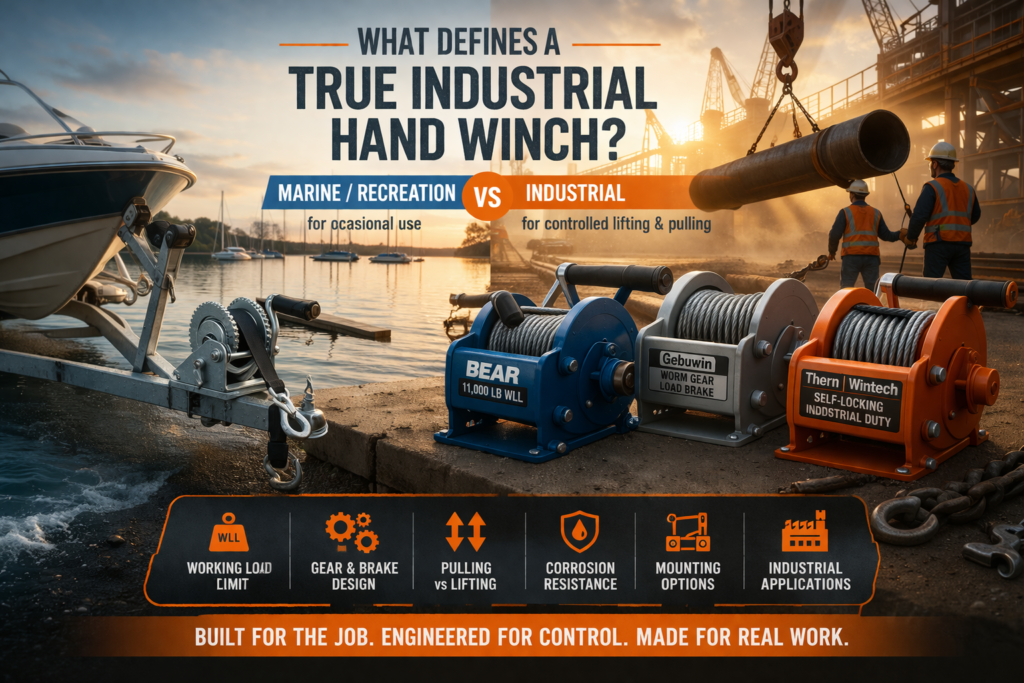
Bear Equipment, Gebuwin, Thern, and Wintech: What Defines a True Industrial Hand Winch?
Not all hand winches belong in the same category. A light trailer winch built for occasional marine or recreational use is not the same thing as an industrial hand winch built for controlled pulling or lifting, defined working loads, and demanding operating environments.
Search for a hand winch online and the same problem shows up again and again. Products built for completely different jobs get grouped together as if they are basically interchangeable. A small boat trailer winch gets discussed beside heavy-duty manual winches built for industrial lifting, pulling, positioning, and load control.
That is where the confusion starts.
It is also why buyers end up comparing the wrong equipment. If the job involves real working loads, controlled operation, fixed mounting, corrosion resistance, or repeated industrial use, then the comparison should not be between industrial equipment and generic recreational winches. It should be between manufacturers that are clearly working in the same class of product, including Bear Equipment’s hand winch range and other industrial names that build around real-duty manual handling.
These products live much closer to the world of lifting equipment selection and control requirements than they do to casual trailer-store hardware. That alone puts them in a different class from the average light-duty marine or utility winch.
The category problem most buyers never notice
A recreational or marine hand winch is usually chosen for a narrow job. Pull a boat onto a trailer. Move a lighter load. Handle occasional use without spending much money. That is a specific product category, and there is nothing wrong with it when the job truly fits.
An industrial hand winch is selected differently from the start. Now the conversation is about application, not just convenience. The buyer has to think about whether the winch is being used for pulling, lifting, or both. They have to think about mounting orientation, brake control, gear type, corrosion resistance, and how the winch behaves under real working conditions.
That difference shows up clearly in the way Bear lays out its industrial range. The line is not built around vague pulling claims or one-size-fits-all marketing. It is organized around WLL, drive type, brake type, handle style, material, finish, and mounting options. That is not how recreational winches are usually presented. It is how industrial equipment gets specified.
Industrial hand winches start with WLL, not guesswork
One of the clearest signs that you are looking at a true industrial hand winch is the way capacity is framed. Serious manufacturers lead with working load limit, not vague headline numbers.
That matters because load on paper is only part of the story. Startup force, drag, angle of pull, duty cycle, mounting geometry, and cable storage all affect what the winch actually needs to do. That same logic shows up in broader CCOHS guidance on pushing and pulling, which makes the point that required force is not the same thing as the weight of the load itself.
This is also where the industrial category starts to separate itself from lighter-duty equipment. In serious load-handling work, the equipment has to be matched to the real conditions, not just the best-case number on a label.
Pulling and lifting are not the same thing
This is one of the biggest sources of confusion online. A lot of content treats pulling and lifting as if they are basically interchangeable. Industrial manufacturers do not.
Once lifting enters the discussion, brake behaviour, cable exit, mounting arrangement, and load holding all matter more. That is why industrial selection needs to be more disciplined. Even in general site safety guidance, documents like the IHSA Hoisting and Rigging Safety Manual make clear that working load limits and hoist behaviour are tied to how the load is actually handled, not just to a headline rating.
That is a major reason industrial hand winches belong in a separate conversation. Recreational winches are often treated as simple crank tools. Industrial hand winches are treated as controlled load-handling devices.
Gear type is a real design decision, not a side note
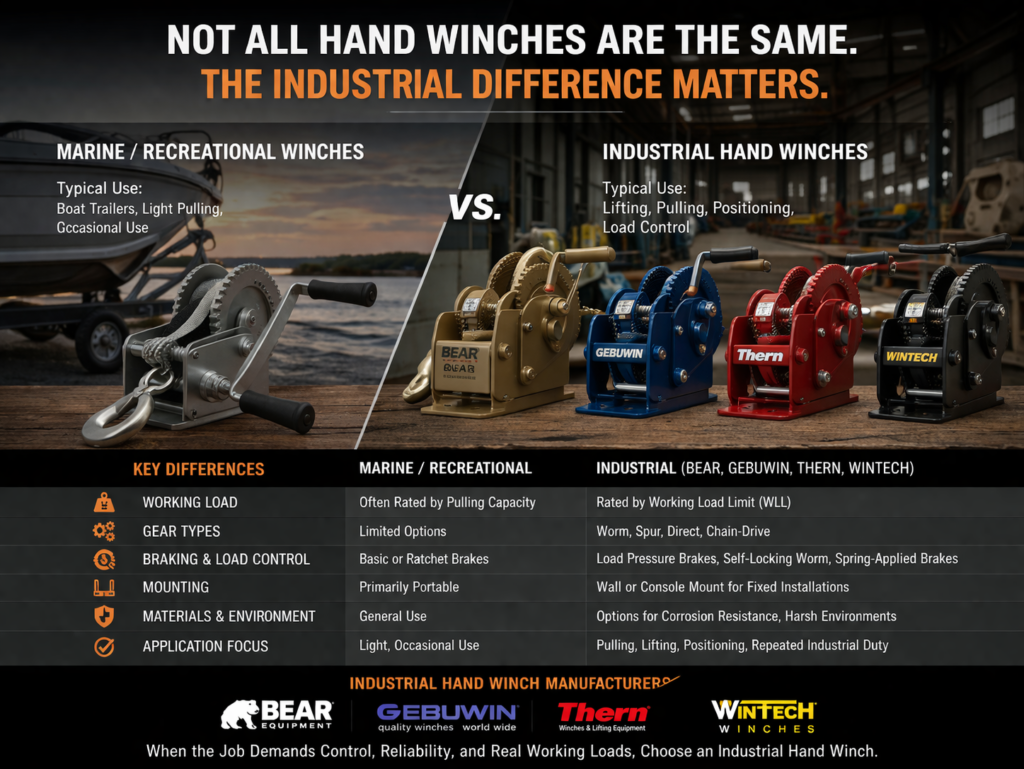
If you want to know whether a manufacturer is speaking to industrial users, look at how it treats gearing.
This is where manufacturers like Wintech make the category difference obvious. When worm gear and spur gear lines are separated clearly by capacity and application, that tells you the winch is being selected by operating behaviour, not just by price.
That same logic applies across the industrial field. Gear arrangement affects how force is transferred, how the load is controlled, and how the winch behaves in actual service. Low-end consumer content often skips past gear type because the buyer is assumed not to care. Industrial users do care, because gear choice affects real-world function.
Brake design is one of the clearest industrial markers
Another place where industrial hand winches stand apart is braking and load control.
This is one of the easiest ways to explain the category difference. A light trailer winch is often sold as a convenience tool. A true industrial hand winch is sold as a controlled manual load-handling device.
That same industrial load-control mindset is easy to see in manufacturers like Gebuwin, where the discussion is built around geared transmission, braking behaviour, and industrial use cases rather than vague general-purpose retail language.
If a winch is being chosen for controlled lowering, fixed-duty operation, or repeat industrial service, brake design is no longer a side detail. It is part of the core selection logic.
Industrial winches are selected for environment too
Another major separation point is environmental suitability.
A lot of low-end winch content acts like “outdoor use” is one generic condition. Industrial manufacturers know that is not enough. Environment matters. Finish matters. Material matters.
That same thinking is obvious in how other industrial manufacturers position themselves. Thern places its lifting and winching products in sectors where exposure, reliability, and repeated duty actually matter. That is a different conversation than simply asking whether the unit will sit inside or outside.
Corrosion resistance, finish selection, material choice, and service environment all become more important once a winch moves into plant, utility, infrastructure, offshore, washdown, or industrial maintenance settings.
Mounting style matters more than most buyers expect
Mounting is another place where industrial hand winches separate themselves from lighter-duty products.
A basic consumer winch is often treated as a simple bolt-on item. Industrial hand winches are usually part of a larger setup, which means mounting orientation and cable exit matter.
That is why serious manufacturers break the category down more carefully. It is not just about attaching the winch somewhere solid. It is about making sure the installed winch works correctly in the intended system, whether the pull is horizontal, vertical, or part of a controlled positioning setup.
Even outside manufacturer literature, this lines up with broader manual materials handling guidance from Ontario, where the point is the same: the task, the direction of force, and the conditions of use matter just as much as the equipment itself.
How Bear compares with Gebuwin, Thern, and Wintech
This is where the comparison becomes useful.
Bear Equipment stands out for how clearly and practically it lays out the industrial hand winch category. The range is easy to understand because it is built around the real selection factors that matter: WLL, pulling vs lifting, drive type, brake type, mounting style, material, and finish. For buyers who want a clear industrial selection path, that is a real strength.
Gebuwin leans heavily into industry breadth and configuration. The company clearly presents itself within a wider industrial lifting environment and ties its winches to sectors where environment and application demands are more serious.
Thern positions hand winches within a broader lifting and positioning ecosystem. It is not just selling winches in isolation. It is presenting them as part of a larger professional handling lineup that includes other lifting equipment and industry-specific solutions.
Wintech does a good job of making capacity classes and gear families easy to understand. Its range spans smaller worm gear hand winches through much heavier spur gear units, and it clearly places some of that lineup in marine-duty and industrial-use territory.
The key point is not that one manufacturer cancels out the others. The key point is that these companies belong in the same class of conversation because they are all operating in the industrial hand winch space.
What defines a true industrial hand winch?
At that point, the better question is no longer “which brand is best?”
The better question is: what actually defines a true industrial hand winch in the first place?
A true industrial hand winch is not just a heavier version of a trailer crank. It is a manual winch selected around:
- working load limit
- defined pulling or lifting duty
- gear type
- brake and load-control behaviour
- mounting style
- material and finish
- environmental suitability
- application-specific fit
That is also why standards and guidance around winches and lifting gear exist in the first place. Even the ASME B30.7 winch standard framework reflects the idea that winches belong in a serious equipment category with construction, installation, inspection, testing, maintenance, and operation considerations.
They are not selling “a hand winch” in the vague consumer sense. They are selling application-specific manual winching equipment.
The real takeaway
If someone is comparing Bear Equipment to a cheap marine trailer winch, they are probably comparing the wrong class of product.
The more useful comparison is between Bear and other manufacturers that clearly design around industrial use, controlled operation, and real load handling. In that context, Bear fits naturally. Its hand winch range is not built like generic consumer gear, and it is not presented like generic consumer gear either.
It is structured the way industrial equipment should be structured: by job, by load, by environment, and by design logic.
That is the clarification the market needs.
And it is also why a buyer looking for a serious industrial hand winch should start with the industrial category, not with the recreational one.